


I was in a meeting a few weeks back, and my boss stood up and announced that this year’s average pay rise would be about 2%. She smiled, and my colleagues smiled back. The news seemed well received.
But I was fuming. Inflation is running at a bit above 4%, so a 2% hike in the number of dollars I get doesn’t compensate for the fact that each of those dollars buys 4% less. In reality, my boss had just announced a 2% real wage cut. Yet no-one was angry.
That’s the mindfuck of inflation: It distorts your thinking, and can lead you to nod when you should shake. And if you aren’t careful, it can lead you to make a lot of mistakes.
So today, I want to give you a user’s guide to living with inflation. If you better understand what’s going on, and how inflation can distort your thinking, you’ll be equipped to make better choices.
Inflation is here, and there’s little you can do about it. But you can control how much it hurts you.
Inflation changes the measuring stick
My favorite textbook tells me that inflation is “a generalized rise in prices.” It means that a given amount of money now buys you less stuff. And so even if you still have as many dollar bills as you had yesterday, it’s like they’ve all shrunk, because you can’t do as much with them.
This leads to an important distinction:
Nominal means the dollar amount.
Real refers to what those dollars buy.
A 2% nominal pay raise gives you more dollars. But if prices rise faster than 2%, those dollars buy less. Your nominal wage went up. Your real wage went down.
That’s inflation’s nasty little trick: It makes the number bigger while the thing you care about gets smaller. That disjunction can cause a lot of problems.
More zeros aren’t the problem
But first, I want to clear up a common misconception. The problem of inflation isn’t the obvious one that inflation leads to higher prices.
To see this, imagine you wake up tomorrow and every dollar amount in your life has an extra zero attached. Your $5 coffee is now $50. Your $1,000 paycheck is now $10,000. Your $2,000 rent is now $20,000. Your $4,000 bank balance is now $40,000. That $10 bill in your wall is now a $100 bill.
In this fairy tale, every price, wage, debt, bank balance, and contract changes the same way. This is one version of “a generalized rise in prices.”
At first, that might sound terrifying, but is it?
Has anything really changed?
You’re not richer. You’re not poorer. None of the fundamental tradeoffs you face — such as how many hours you need to work to buy a coffee, or how many years of income your savings represent — has changed. Indeed, nothing real has changed. The world simply has a lot more zeros in it. Beyond this, your economic life is the same.
The measuring stick has changed, not the stuff being measured.
This is why economists can sound oddly calm about inflation — at least in theory. If every dollar number adjusted instantly and proportionately, inflation would mostly be an accounting nuisance.
It often doesn’t feel this way. That’s because of what we call the inflation fallacy. Too often people worry about the prices they pay rising, but fail to appreciate that the prices they receive for what they sell — your wages, investment returns, or social security — also rise when inflation, that “generalized rise in prices,” occurs.
But this misperception is not the whole story. Real life is messier. Or foggier.
Inflation creates fog
In reality: Prices don’t all change at once. Wages don’t automatically keep up. Your rent may reset this month, while your salary review happens next year. Your checking account pays you essentially nothing. Your fixed-rate debt may stay fixed. Your long-term contract may have been written as if the dollar would sit still and behave itself.
That’s where inflation starts to bite.

Inflation can also distort your decisions. It creates a fog, making it harder to see economic reality. Inflation changes what a dollar can buy, and so distorts the very meaning of what a dollar is. In most of economic life, you treat a dollar as a measuring stick, helping you compare one thing with another. But inflation makes the measuring stick shrink while you’re using it. It’s harder to figure out whether your boss just gave you a meaningful raise, whether the mortgage rate you’re offered is high or low, and whether the price of something is temporarily high, or just part of a generalized drift up.
Worse, higher inflation is usually more unstable, harder to predict, and harder to plan around.
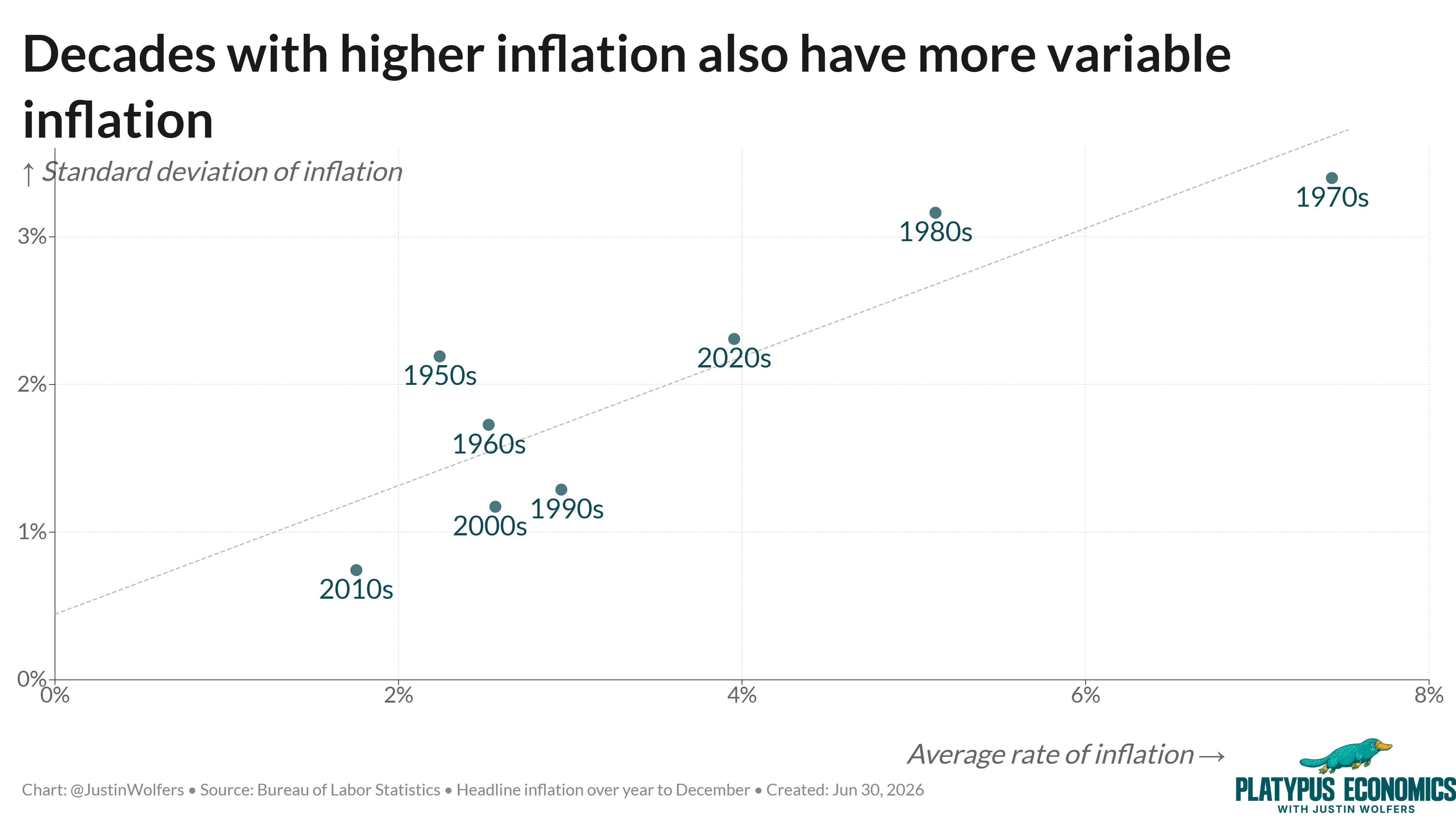
When inflation is low, you can mostly get away with ignoring it. The mistake you might make — confusing nominal and real wage rises as my colleagues did — aren’t of much consequence when inflation only drives a small wedge between them.
When inflation is stable, you can’t ignore it, but you can plan around it.
But when inflation is high, it also tends to be variable. This was the story of the 1970s and 1980s, and arguably it’s become true (to a lesser degree!) in the 2020s. And so today’s problem is that you can neither ignore inflation, nor plan around it.
The mistake that my colleagues made — cheering on a nominal wage rise even as their spending power fell — is called money illusion. The cure is practice. And a few simple rules for minimizing your mistakes and the pain they cause.
Five ideas for minimizing the pain of inflation
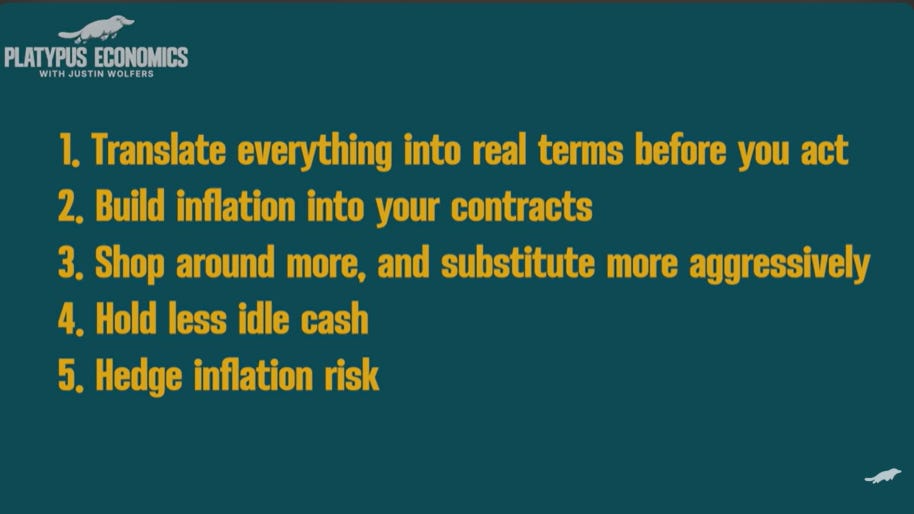
Here are the five ideas I’d use for living with inflation.
Idea #1: Translate everything into real terms before you act
Before you react to any dollar number, translate it into real terms, evaluating it in terms of what really matters — purchasing power and its opportunity costs — rather than nominal terms.
The following illustrates the point. It’s a true story, with a few details changed to protect the guilty. A (very smart!) non-economist friend of mine was negotiating a raise. His boss offered a contract that would increase his pay by 5% over five years. That sounded like progress, and he was pretty pleased with himself.
But inflation was running around 2% per year. Over five years, prices would rise by roughly 10%. So a 5% nominal raise over a period when prices rise 10% is roughly a 5% real pay cut.

His mistake was to focus on nominal rather than real wage gains.
So we hatched a strategy, which was all about shifting the reference point in his next conversation with his boss. You should try it too: Walk in, and suggest that before you start negotiating, we agree on what your current real wage is. Make that the reference point, and then begin by negotiating from there.
That shift in perspective changed the whole conversation. His boss agreed that — at a minimum — he deserved the same real wage. Then they started negotiating, noting that he had become more valuable to the company and that his hard work merited a real raise.
And it worked. My mate negotiated a much better contract. You can do the same.
Idea #2: Build inflation into your contracts
If you’re writing a deal that lasts over time, build inflation into it. Economists call this indexation, which is a wonkish way of saying that the dollar amounts should automatically adjust when the price level changes.
This matters whenever today’s dollar amount is meant to govern tomorrow’s life: wages, leases, retainers, child support payments, pensions, and long-term contracts.
If prices rise 5%, and your contract automatically adjusts by 5%, you don’t have to re-fight the same battle every year. You can still argue about the real raise you deserve, or the real change in child support that’s fair. This strategy isn’t just effective, it makes sense: It recognizes that the measuring stick — the value of the dollar amounts you’re negotiating — has changed.
Without indexation, every inflation adjustment sounds like a new demand. With it, the contract says what’s really happening: dollars are worth less, so the dollar amount needs to change.
That’s preserving the bargain.
Idea #3: Shop around more, and substitute more aggressively
Inflation usually arrives through staggered price changes. One store updates prices this week. Another does it next month. One brand jumps. A substitute doesn’t. One insurer raises your premium and hopes inertia does the rest.
That means the payoff to shopping around rises.
In calmer times, old habits are cheaper. You renew the same policy. You buy the same brand. You keep the same phone plan. You let the streaming services nibble away at your bank account like tiny, well-capitalized termites. Sure, you won’t get the perfect deal, but pretty good is often good enough.
But when inflation is high, old habits are no longer pretty good. Indeed, they can be pretty expensive.
The danger is the shrug. You see a price increase and think, “Well, everything’s expensive now.” Sometimes that’s right. Sometimes it’s inflation. But sometimes it’s a relative price change. Sometimes it’s a seller testing whether you’re paying attention. Sometimes it’s a signal that your old choice is no longer the best choice.
So shop around more. Substitute more aggressively.
Buy the cheaper brand if the old one jumped. Get a second quote. Re-shop your insurance. Inflation rewards super shoppers, so become a super shopper.
Idea #4: Hold less idle cash
Inflation taxes money that sits still. The dollars in your wallet are getting smaller each minute they sit there. So don’t leave them there.
This idea applies beyond just the cash in your wallet — it also applies to money sitting in payment apps, and balances in checking accounts that pay little or no interest. When inflation is higher, interest rates are often higher too, which raises the cost of leaving money idle.
If your checking account pays essentially nothing while safe alternatives — like savings accounts — pay more, inertia is costing you money. Get in the habit of sweeping excess balances from your checking account into savings.
Idea #5: Hedge inflation risk
If inflation risk worries you, use tools designed to hedge inflation risk.
The cleanest example is inflation-indexed government bonds. In the United States, that means instruments like inflation-indexed bonds (called “TIPS”) and I Bonds. Their appeal is simple: the inflation adjustment is written into the contract. If inflation rises, the payoff adjusts. Your purchasing power remains guaranteed, even as inflation rises and falls.
Sometimes people talk about alternative assets — like gold and bitcoin — as a hedge. Don’t listen. Their prices may rise when inflation rises, but a hedge is supposed to reduce risk. Gold and bitcoin are volatile. They’re up and down like a kangaroo on Red Bull. If the money is meant to protect purchasing power for some real-life need, replacing inflation risk with roller-coaster risk won’t help.
A hedge should be boring. That’s sort of the point.
The goal is to know what problem you’re solving. If the problem is that inflation might erode the real value of your savings, look for assets whose payoffs are linked to inflation. If the payoff isn’t linked to inflation, it may still be a fine investment. But it’s not automatically an inflation hedge.
Ask what the dollars will buy
Let’s return to my boss announcing that 2% pay rise. It was a faculty meeting, with some of the most brilliant people I know. They’re not all economists — this was the public policy school — but they’re smart. They heard the number was going up. That was true. But the truth that mattered was what the number would buy. Even brilliant people failed to see this (obvious?) reality.
But that’s the habit inflation demands. When someone announces a raise, a deal, a rate, or a payment, don’t just listen for the dollar amount. Translate it.
The next time someone tells you the number has gone up, pause before you clap.
Ask whether your purchasing power went up too.
Look, you can’t choose the inflation rate, but if you follow these five strategies, you can choose how much it costs you.
One more thing (for the stats nerds and their teachers)
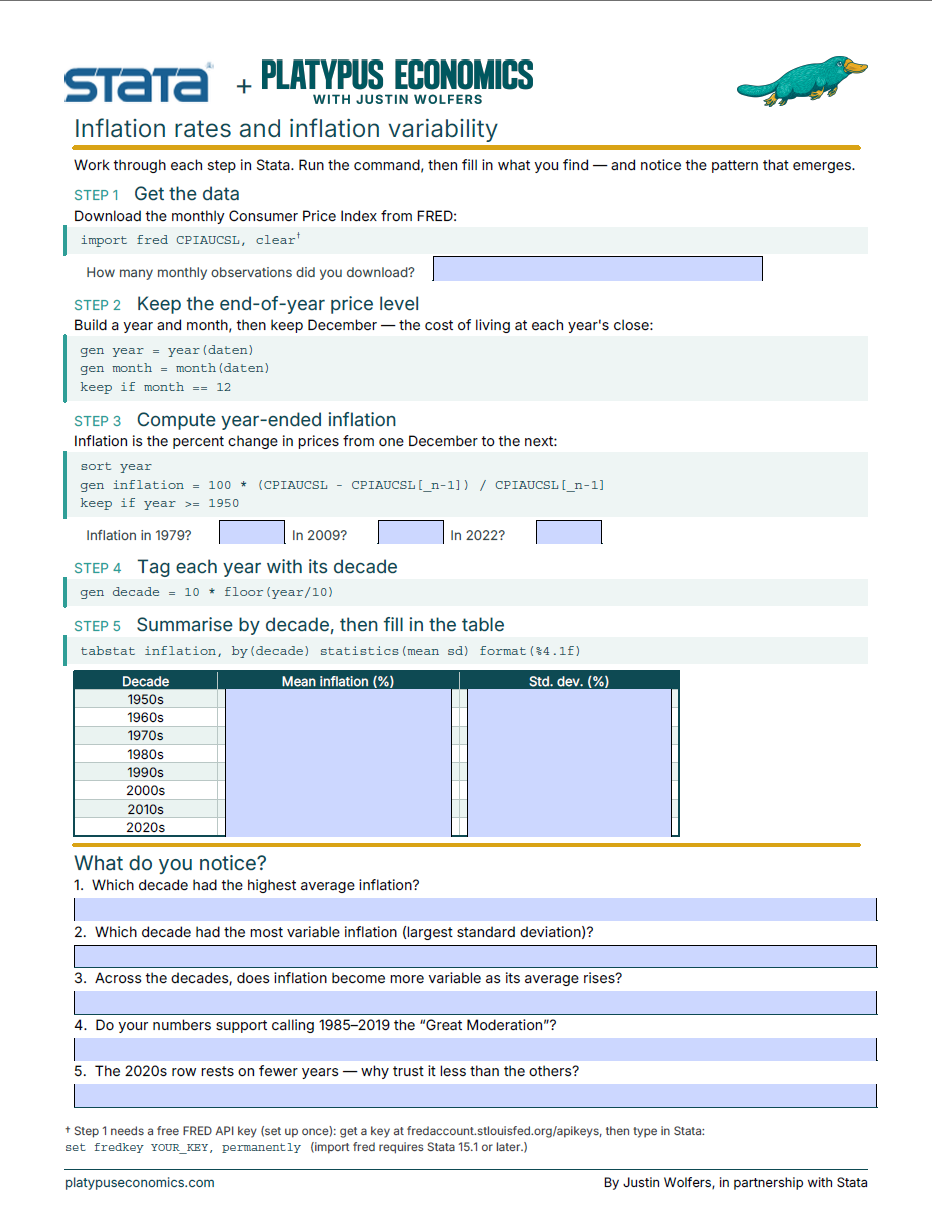
When I write these posts, I often crunch a few numbers in Stata — and today, it was all about illustrating that higher inflation tends to be more volatile. I’ve started a fun partnership with Stata, and so I’ve put together a worksheet that Stats teachers — or the statistically curious — might find useful. Click through here, if you want to work through the steps I followed, and build your statistical mastery.
Let me know if you find these useful because I can keep producing them. I would love it if this is useful in your stats class, or as you’re trying to build your own statistical superpowers.
Great article. Makes me move cash out of a couple of our bank accounts. Re grocery shopping: I try to buy produce that is in season and “local.” Thanks. Richard Barron
This really happened to me. I’m an old fart, but was working in management in the Steel Industry in 1974. My boss announced to the office that we were all getting 5% raises… but the inflation rate (had any of my fellow wingnuts cared to check) was above 11%! I remember there were actual cheers in the room! I left 2 months later to enter a PHD program in Statistics and Econometrics. Finished too, and now, like you, live off the fat of the land.